Looking Beyond Individual Data Breaches: A Hybrid Threat Perspective
 Data breaches are often treated as isolated cybersecurity or compliance events—important, but largely self-contained. Each incident is investigated, reported, and then replaced by the next headline. Many never make the headlines at all.
But what if data breaches are not just discrete incidents? What if, when viewed collectively or over time, they reveal broader patterns, targeting logic, or strategic intent?
In today’s risk environment, hybrid threats increasingly shape how vulnerabilities are identified and exploited. Hybrid threats blend cyber operations, information manipulation, economic pressure, and covert influence to disrupt systems or shape decision-making—often below the threshold of clear attribution or open conflict. These activities are deliberately difficult to detect when analyzed in isolation.
In this context, data breaches are more than standalone cybersecurity or compliance events. Information obtained through breaches—particularly when aggregated over time or across entities—can contribute to broader hybrid threat campaigns by revealing organizational structures, operational practices, supplier and vendor relationships, and patterns of behavior that may be exploited in future actions.
Not every data breach is part of a coordinated hybrid threat campaign. However, data obtained through one incident may later be aggregated, resold, or repurposed by other actors, including those pursuing strategic, commercial, or geopolitical objectives. A single breach may appear limited in scope, but it can still represent one data point within a broader and evolving risk landscape.
A New Lens for the CRA’s Data Breach Brief
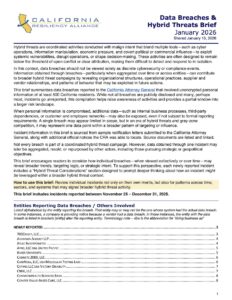 To reflect this reality, the California Resiliency Alliance (CRA) has reworked its Data Breach Brief to encourage subscribers to look beyond individual incidents and consider how breaches may fit into a larger context.
The brief summarizes data breaches reported to the California Attorney General involving the unencrypted personal information of at least 500 California residents. While public reporting provides only a partial view—and many incidents go unreported—this compilation helps raise awareness of recent activity and emerging patterns.
What’s new is the addition of a Hybrid Threat Considerations section for each newly reported incident. This section is not intended to assert attribution or intent. Instead, it is designed to prompt deeper thought about how an incident could be leveraged, combined with other data, or viewed as part of a broader pattern when analyzed through a hybrid threat lens.
Readers are encouraged to review incidents not only on their own merits, but also for signals across sectors, systems, and timelines that may point to systemic vulnerabilities or sustained targeting.
About the California Resiliency Alliance
The California Resiliency Alliance (CRA) is a nonprofit organization dedicated to strengthening resilience across California by equipping professionals with actionable knowledge, closing cross-sector gaps, and fostering collaboration that strengthens resilience statewide. The CRA curates and shares trusted information to support planning, preparedness, and decision-making across public, private, nonprofit, and academic communities.
Through its briefings, reports, and information-sharing products, the CRA helps professionals make sense of complex risk landscapes—connecting dots across disciplines, sectors, and time horizons.
Stay Informed
CRA subscribers receive insights on emerging risks, data breaches, weather and hazard activity, and broader resilience issues affecting California and beyond. Subscription options range from basic no-cost access to enhanced and organization-level tiers that support deeper analysis and broader information sharing.
Subscriptions are open to professionals with operational or organizational resilience responsibilities, including emergency management, business continuity, cybersecurity, and infrastructure security.
Subscribe to join a growing network of resilience professionals working to better understand—and navigate—today’s complex risk environment.
Posted: January 15, 2026